About

Friday, August 11, 2017

Bent's Old Fort


Bent’s Old Fort

Imagine being the only store or trading post within 500 miles. Those folks who failed to plan ahead and to prepare for every contingency often didn’t survive the harsh life on the western prairie in the 1830-1860s. Bent’s Fort became the primary store for early fur trappers and pioneers in the American West.

If you a visitor - welcome! If you'd like to receive this blog on a regular basis, please join  by clicking the following link. If you join, I'll give you a copy of my western book, The Posse.

http://bit.ly/ThePosseWEB


Charles and William Bent partnered with Ceran St. Vrain to form the Bent, St. Vrain & Company and build a series of fur-trading posts on the western prairie. The first post, Fort William, now known as Bent’s Old Fort, was constructed in 1833 on the north bank of the Arkansas River. William managed the first Fort. The Arkansas divided U.S. territory from Spanish/Mexican territory south of the river. Spanish Law prohibited entry by Anglos and non-Catholics, which explains why so many French Catholics were among the early traders in Taos and Santa Fe.


 (The press above compressed hides for shipment, making bundles easier to load and ship.)
Bent, St. Vrain & Company built three trading posts; Fort William in 1833, Fort St. Vrain at the confluence of St. Vrain Creek and the S. Platte River (north of present-day Denver) in 1837, and Fort Adobe in 1843 on the Canadian River in the Texas Panhandle near present-day Stinnett, Texas.
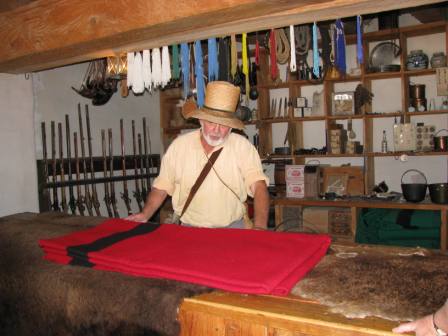
The Bent’s employed a crew of Mexican adobe craftsmen who created 2-story log-framed buildings and courtyard walls, which were encased in adobe bricks and often finished with a whitewash slurry to give a decorative appearance. Each of the Forts had a similar style of a defensive wall surrounding the trading post. (The pic below represents the types of items sold at the trading post.)

 In its heyday, Bent’s Fort became the stopping point for those coming west. In the Spring, the first wagons west from the Missouri River ports of Lexington, Independence, and Westport Landing carried frozen barrels of oysters that had wintered outdoors. The barrels stayed frozen or chilled until they reached Bent’s Fort, where the oysters became a prized, and pricey, item on the Fort’s menu.
In its way, the Fort became an Inn, where traders could rent a bed (not a room) and buys meals at a community table. The upper floors contained gaming rooms and a billiards table.
(The pic below is the billiards and gaming room. Yes, they sold spirits, but to Anglos only.)

 (The pic above is representative of the types of pelts and hide traded at the post in exchange for other products, like powder, lead (shot), flint, and "necessaries," like knives, pots, dry goods (flour, sugar))

Keep in mind, the Fort’s primary role was buying fur pelts and buffalo-hides to ship east (above). The people selling pelts and hides most often were the Plains Indians. The Bent’s insisted the trading posts be treated as neutral territory—they banned truce breakers from trading. The Bent’s had a reputation as fair traders, which is evidenced by the number of tribes who visited and traded with the Bent’s for more than a dozen years. The open ground surrounding the Fort provided ample camping and water for visiting tribes, without forcing unfriendly tribes next to one another.
Pic below is a comon room which held several bds in its original use.)


These rooms are on the second floor offering sleeping and meals.

In 1846, following provocations on the lower Rio Grande valley, the United States declared War on Mexico (now independent from Spain.) 
The Army took over the Mexican government of New Mexico, replacing them with Anglos from the Area. Charles Bent was appointed the termporary governor by General Kearney in 1847. The Pueblo Indians, angry at years of forced slavery under the Mexicans, saw this as a time to displace all white men, and staged a revolt. Before order was restored by the US Army in Santa Fe, Charles Bent was killed and St Vrain wounded. Several other prominent leaders, both Mexican and Anglo, were killed or injured.
After the Pueblo Revolt, St. Vrain sold his interest to William Bent, and retired to St. Louis with his brother. Ceran St. Vrain returned to the Taos area years later, when hostilities settled.

The US Army drove William Bent out of business by commandeering the fort for several years. The Army’s presence drove away the Indian tribes who once traded there. The Army proposed to buy the Fort and surrounding land from Bent, but negotiations dragged out until the War ended, after which, the Army no longer needed the facility. A civilian official from Washington visited the Fort early in 1849, declared it uninhabitable, and offered Bent little to nothing for the land, which was now bare from thousands of Army horses and mules trampling the land.


 Interior Pics on the ground floor.

William Bent became so frustrated with the negotiations, in 1850 he ordered the Army from his premises. He removed the trade goods of value, taking them north to Fort St. Vrain. Within days of ordering the Army from his land, William Bent ignited the powder magazine, destroying the Fort buildings. Some of the walls surviced for many years. Thus ended an era of US history.


Later, William Bent built a new trading post along the Arkansas, east of the old Fort, which was called Big Timbers for the cottonwoods in the area. Big Timbers never regained the Bent’s status because his primary traders were the Plains Indians, who were fighting a losing battle with the US Army while trying to preserve their way of life.

The next two blogs will relate the history of Fort St. Vrain and Fort Adobe (Also known as Adobe Walls.)

 If you are a visitor and would like to receive Traveling the West regularly, please click the following link to join my blog list. I f you join, I'll give you a copy of my western book, The Posse.

http://bit.ly/ThePosseWEB

Thanks for riding along,
Frank Kelso


Wednesday, August 2, 2017

Fort Clark and Brackettville


If you are a visitor to this post and would like to receive Traveling the West regularly, you can join at http://bit.ly/ThePosseWEB
If you join, you'll receive a free copy of my western book, THE POSSE.


Fort Clark, Texas

Did you ever want to live in a historic cavalry post? Have I got a deal for you? ;-)
You can own your own two-story barracks, or one of the officer’s quarters, at Fort Clark Springs. An enterprising developer bought the entire Army post in the 1970s to make the historic buildings available for sale to private owners. The stone buildings, built in the 1880s, are protected under the National Historic Registry to preserve the original design of the Army Post. This means if you buy a building, you can modernize the interior, but you must leave the exterior in historic condition to preserve the heritage.
The US Army established Fort Clark in 1852 as part of the Treaty to end the Mexican-American War of 1848, which led to creating the border we recognize today. The Treaty acknowledged the responsibility of the Federal government to prevent Indian raids into Mexico. The Comanche, Lipan Apaches in Texas made annual journeys across the Rio in the winter, first to gather food, horses, and women, and second to escape the harsh winters on the upper plains.
To cross the arid west Texas desert, the Comanche relied on springs to rest and water their horses and themselves. Whatever name the Comanche once called the springs at Fort Clark has become lost in the white man’s version of history. The Spanish called the springs, and the creek it feeds, Las Moras. As part of the Treaty, the Army also created Fort Stockton in west Texas near what the white man called “Comanche Springs.” Another of these Army posts was Fort Duncan in Eagle Pass, Texas. The Army established similar posts in New Mexico and Arizona to limit raids from the Apache native to those areas. The strategy was to deny the “Indians” a place to rest or regroup before and after raids into Mexico, and it worked.
The scarcity of building materials led the Army to leave these posts open, that is not enclosed by a stockade or walls. When wire fencing became practical, the Army enclosed the post with these fences. I mention this in case you wanted to visit to warn that you would NOT find a Hollywood style wooden stockade with a wooden gate.
For historical reference, the Buffalo Soldiers were stationed here, along with the well-known Seminole-African Scouts. Colonel Ranald Mackenzie operated from this post when he ended the Comanche wars after his winter attack on Palo Duro Canyon, the winter haven of the Comanche. These soldiers played an important role in ending the Indian Wars in Texas. In more recent history, General George S. Patton served as the post commander in the 1930s when it still had the last mounted Cavalry unit in the US Army.
The Post Visitors Center has an extensive collection of period weapons, Cavalry gear and sabers. I always surprised at how much of these materials survived to create an great exhibit.

The little village outside Fort Clark’s gate may be well known to many of you—Brackettville. Founded as a water stop on the San Antonio-El Paso mail road, the town flourished when Fort Clark was an active post. When Fort Clark closed, the town faded.
In it's time (1865-1930), Brackettville was the poster-boy for sordid saloons and red-light districts, litterally across the street, from the Army post's front gate. If there was any written record, it became lost. I couldn't find any newspaper accounts. of events such as shootings or arrests.
Its well-known neighbor, the Alamo movie location and buildings, closed to the public several years ago, but is available if you want to shoot a movie.
Before you get the impression that buying a house to live on this post is the end of the world, Uvalde is a 30-min drive east, where shops, services, Wal-Mart, medical offices, and a hospital are available. Uvalde is a small, friendly town who welcomed this stranger.


 The pic on the right is the springs lake. There also is a pool and swimming area.

I remind everyone, my next book, California Bound, launches on Aug 16. You're invited to attend the Facebook Party from 8-9:30 PM https://www.facebook.com/CABoundBook/

If you are a visitor to this post and would like to receive Traveling the West regularly, you can join at http://bit.ly/ThePosseWEB
If you join, you'll receive a free copy of my western book, THE POSSE.

The pic below is the Post Commissary and Quartermasters Building.

Friday, July 28, 2017

The Pioneer Women

The Pioneer Women

In late June, I attended the Western Writers of America Conference in Kansas City, MO, which is the trail-head for the Santa Fe, the Oregon, and the California Trails. Kansas City takes great pride in its statuary and its fountains. Two memorable statues in Kansas City for me are the Pioneer Mother (http://bit.ly/2uvkSqz) in Penn Valley Park near downtown, and the Pioneer Crossing Park (http://bit.ly/2t2MXRK) in the nearby Shawnee Mission area of Kansas. Earlier in the year, we detoured east from I-35 to visit Ponca City, OK, to visit the Pioneer Woman Museum, home of an equally well-know statue of the Pioneer Woman.
These memorials pay tribute to the role strong-willed women played in developing the West, as we know it today. While each bronze is unique, all three emphasize the role of mother and child. The family produced a leavening effect on a wild, untamed, and uncharted land. The family reminded all of the fundamental fabric of society, the marriage of man and woman, who were to procreate and work the land.
The society of the mid- to late-1800s placed a multitude of restrictions on a woman’s role. However, the rigid societal structure weakened after crossing the Missouri border into the territories. The nature of the quest forced women to become an active partner, for survival, if for no other reason.
Each of us has our version of the strong-willed, determined woman standing beside her man, reloading the cap-and-ball rifles to ward off marauders. If the man fell, the woman picked up the rifle, continuing the fight to save herself and her children. The surviving woman, now a widow, faced a different life, then as now.
Life for a single mother in 1866 wasn’t all that different than in 1966. If a woman decided to remarry, she uprooted her family to move with her new man. In the process, the mother and the children experience a lot of anxiety about their new life. In my story, Tibby’ Hideout, Bess Newcomb says yes to a traveler who visited her twice a year while he carried trade goods to and from San Antonio. He wrote her wonderful letters. After accepting his proposal, Bess loads her family and their belongings into her Studebaker station wagon to move to Las Vegas.
Wait you say—“They didn’t have Studebaker cars in 1866. Where’d she get a Studebaker?” 
Studebaker of 1966 was the same company that built sturdy, reliable overland freight wagons and smaller station wagons in 1866.
What about LasVegas? It wasn’t there in 1866.
No, this is not the one in Nevada. In 1866, travelers on the Santa Fe Trail found Las Vegas, New Mexico, as the welcome last stop on the prairie before climbing into the mountains to reach Santa Fe.
As often experienced by new families, Tibby Newcomb wasn’t ready for a new father, or for moving from Comfort, Texas, and leaving his grandpa behind. Eight-year-old Tibby’s solution was to run-away. His Ma called him the “man of the house,” ever since he could remember. “Got her a new beau—she don’t need me anymore.” Tibby’s childish logic leads him into trouble.
Bess’s treatment of Tibby’s misbehavior may shock some of today’s readers. I remind those readers that in 1866 “Spare the rod, spoil the child,” was more than a sampler on the wall—they put it to practice. Bess gives Tibby a knuckle pop on the head when he says, “dang.” She yanked him up straight by the hair of his head for sassing her.
Tibby finds the ideal place to hideTrue to the Union, Bess fought two battles to defend her home and children. Once again, Bess must step up when her new husband falls wounded. The new family survives the encounter, a little worse for the wear. HEA.
, expecting his mother to leave him behind with grandpa. It’s such a good hideout, a gang of rustlers uses it—much to Tibby’s surprise. A reluctant Tibby leads the rustlers to Bess. In her first story,
The women who settled the west, as portrayed by Bess, became determined and strong-willed to survive the harsh land. The same respect is due those women who ventured west to marry strangers. They were not “came later” or “moved here,” (as opposed to “born here.”) These women rolled their sleeves, pitching in to stand by their men. The memorial statues mentioned in the opening were created to honor all of those pioneer women.

But wait…there’s more!
Tibby’s Hideout is one of my short stories in the anthology of eight western romances called The Posse. It’s available on Amazon, but if you want a free ebook of The Posse, join my blog, Traveling the West, and I’ll send you a copy—free! http://authorfrankkelso.blogspot.com

Bess is the protagonist of a Chapter book series, The Pioneer Woman, I plan to release in the summer of 2018. Bess, her sons Tibby and Isaiah, and her new husband, Joe Robidoux, will have more adventures.


Thursday, July 20, 2017

Cowboy Day

Today, I'm sharing the post from an author friend. I liked what she had to say about being a "cowboy" isn't about wearing the boots and hat, it about living by the "cowboy code." I hope you like as much as I did.

If you get this post from FB or shared from a friend and you want to join, click http://bit.ly/ThePosseWEB      If you join up, I'll give you a free copy of The Posse.

~~~~~~~~
National Day of the Cowboy: Celebrating an American Icon
By E.E. Burke           https://www.facebook.com/AuthorEEBurke/

July 22 is National Day of the Cowboy. We in American have set aside a special day to recognize and celebrate cowboys.
What it is about cowboys and the cowboy lifestyle we find so compelling? I asked this question of other authors and got surprisingly similar answers. Or maybe it’s not so surprising.
Summed up, we all share a deep love for the iconic cowboy. He’s the hero of our romance novels, he has equal parts courage and honor, and he follows a code of ethics that don’t just guide him, they define him.


Historically, the “cowboy code” wasn’t a set of laws or statutes, it wasn’t even written down. Rather, it was about core values, and an unspoken understanding about how one should behave—in public and in private. Here’s a nice summation:

1) Live each day with courage.
2) Take pride in your work.
3) Always finish what you start.
4) Do what has to be done.
5) Be tough, but fair.
6) When you make a promise, keep it.
7) Ride for the brand.
8) Talk less and say more.
9) Remember that some things aren't for sale.
10) Know where to draw the line.

Even today, this “cowboy code,” or “code of the West,” speaks to us. Why?
I think it’s because it inspires us to be better than we often are, and it reminds us that these are the kind of values that will truly make a nation great.

But makes a cowboy a cowboy? It isn’t putting on jeans and boots and a hat, and driving around in a truck listening to country music, or displaying guns, or flying your colors. Feel free to do all that (this is what freedom grants you), but if you’re coarse and rude, or dishonest and lazy, the rest of package doesn’t matter. True cowboys, using the iconic definition I talked about earlier, are those who live by “the code.”


A little cowboy history

In reality, the original “cowboys” were mostly young men in their late teens and early twenties, who sought adventure and money as drovers taking cattle across rough, often hostile, country. They worked long hours, often through sleepless nights, keeping the herd together, safe and pointed north until they reached the rail-head. Most of the men who worked this job didn’t even own the cattle. If the owner was a rancher, he might ride along, but not always; and sometimes the owners were businesses, not individuals.


It generally took upwards of three months to reach the rail-head, where the cows would be loaded to be taken east to a slaughterhouse. Most of the cross-country cattle drives (such as the ones we think of when we hear “The Chisholm Trail”) were made in the early 1870s, before the railroads connected Texas to eastern markets.

Cowboys faced natural disasters (frequent storms and flooding), stampedes caused by any number of factors, inhospitable strangers, such as the farmers who hated the Texas cattlemen because of tick fever … and the list of obstacles goes on and on. Cowboys relied on physical vigor, cleverness, and sheer determination, along with the experience they gained along the way.


Out on the frontier, cowboys had to depend on each other’s character rather than depend on a set of written laws. In fact, the cowboy tended to be a mite independent (translate that, stubborn as a mule’s hind end). He might flaunt the law of a territory or state, particularly if he didn’t think it made sense, but you could count on him to abide by the code. Those who didn’t were drummed out of the brotherhood, at the very least.

Yes, cowboys could be wild, and at times, violent. They could also be generous, loyal and considerate, particularly to ladies. Were they perfect? Hell, no. And I’m betting they’d laugh if someone told them today they’re considered heroes with a special day set aside to honor them.


I’d like to introduce you to Texas Hardts, which follows a family steeped in the cowboy code.

Seducing Susannah, The Bride Train https://www.amazon.com/dp/B01NB22Y6G/

Ross Hardt must marry a proper lady to reclaim his inheritance. Among the few remaining prospects is a beautiful, sassy widow who has tantalized him from the day they first met--the same day she slapped his face.

Susannah Braddock journeyed west on The Bride Train in search of agood father for her young son, but on the lawless frontier few candidates meet her requirements, least of all the arrogant, demanding, unfeeling railroad agent.

As Fate—and Ross’s scheming—draws them closer, Susannah glimpses unexpected tenderness beneath his harsh exterior, and she’s tempted by the fiery passion that flares between them. But when a secret comes out that threatens to destroy their budding relationship, passion isn’t enough. Only love can weather the oncoming storm.

Seducing Susannah features the founders of a legendary Texas ranch, and Maybe Baby kicks off a series about their descendants


Maybe Baby, Texas Hardts            https://www.amazon.com/dp/B01N7YAQDF/

Jen Chandler can’t ignore the urgent ticking of her biological clock, no matter how many hours she puts in at work. The nesting instinct has kicked in big-time, and she wants a baby. After too many failed relationships, plus issues with intimacy, she isn't interested in obtaining a husband. Instead, she sets out in search of a sperm donor to make her dream come true.

Logan Hardt, a laid-back cowboy who shows up at her Atlanta home one day, turns out to have the right genes, as well as a pressing need for cash. But he's seduced by more than Jen’s generous offer, and the closer the time comes to say goodbye, the less willing he is to honor a contract that would require him to walk away and never look back.

Could a contract between them lead to more than a baby? Maybe.

~~~~~~

Thanks for reading Elisabeth's Blog. Post a thank you on FB or Tweet on National Day of the Cowboy. It's all about honoring our past and respecting those who blazed the trail.

If you get this post from FB or shared from a friend and you want to join, click http://bit.ly/ThePosseWEB      If you join up, I'll give you a free copy of The Posse.


Tuesday, July 18, 2017

Uvalde Texas

If you like this blog and would like to join, click http://bit.ly/ThePosseWEB
If you sign up, I'll give you a free copy of The Posse

Uvalde Texas

The short sentence from the Texas State History Association describes the west Texas town of Uvalde: Founded in 1853 … border warfare and lawlessness prevailed until the late 1880s.
If you’re a fan of “the old west,” Uvalde sat at the crossroads. The San Antonio-San Diego Mail route passed through Uvalde, heading for Del Rio and then to El Paso on the way to San Diego.
Another road led south to Eagle Pass on the way to Saltillo, Mexico. This road was the western trail of the El Camino Real to Mexico City. From the days, when Texas was under Spanish/Mexican rule, it was the primary commercial road from San Antonio to Saltillo.
The nearby Nueces River fed the wells and springs in Uvalde, making it an oasis in the west Texas desert. The Nueces flows from springs at the edge of the Edwards plateau in the hill country north of Uvalde. The Nueces meanders across south-central Texas from Uvalde to Three Rivers, Texas. The Nueces Plains formed a vast fertile prairie. During the Civil War, longhorn cattle roamed free to become the source of tens of thousands of beeves driven north in the great cattle drives of the late-1860s and 1870s before expansion of the rail system ended cattle drives.
I spent an afternoon prowling through the Virginia Wood Davis Archives in the El Progresso Memorial Library in Uvalde. I had the pleasure to meet and speak with Virginia, the well-known curator of the Archives. My visit was typical of visiting any library or bookstore—wanting to sit and read every book in sight.
My wife reminded me, “You schedule more things to do than we have time to do them.”
I found one interesting story of a ne’er-do-well in 1889, arrested for drunk and disorderly, turned on Sheriff Daugherty shooingt him dead, only to killed himself by a deputy. This Daugherty was no relation to the well-known Texas cattleman and early cattle trail driver.
In 1881, Uvalde hired a deputy sheriff named John King Fisher. What made it remarkable was Fisher had a reputation as a murderer, rustler, and horse thief. Fisher claimed, after his marriage in 1876, that he mended his ways. He bought a small ranch between Uvalde and Eagle Pass, staying out of trouble with the law until Uvalde hired him as a deputy. Within a few months, a country grand jury indicted the elected sheriff on corruption charges. County officials appointed Fisher the Acting Sheriff. A likeable fellow and efficient at keeping the peace, he made friends in Uvalde and planned to run for election in 1884.
To celebrate his rise in politics, an old pal of Fisher’s from his outlaw days, Ben Thompson, a notorious gunman in his own right, and the off-and-on elected City Marshall of Austin, invited Fisher to meet him in San Antonio.
Six months earlier, Thompson, while City Marshal of Austin, visited the Vaudeville Theater in San Antonio. In the back rooms, he entered a card-game with the theater owner, Jack Harris. The two quarreled over cards leading Thompson to shoot Harris. After a sensational trail, Thompson was acquitted, but he won no friends in San Antonio.
In an act of bravado, on the evening of March 11, 1884, Thompson and Fisher visited the Vaudeville Theater. After entering the darkened theater, Thompson and Fisher were shot in the back, killing both men. Following another sensational build up, a coroner’s jury ruled the deaths in self-defense, No one was ever charged with either murder.
Despite all the accusations of Uvalde be a rough town, few records exist to document any shooting or outrageous behavior. It may have happened, but “ain’t nobody talking about it.”

If you like this blog and would like to join, click http://bit.ly/ThePosseWEB
If you sign up, I'll give you a free copy of The Posse.


Modern day Uvalde is a pleasant community. It is know as the spinach capital of the US, where water from the Nueces irrigates miles of flat lands south of the city. The most unusual relic in the area is a large abandoned plot that once housed the largest Internment Camp in the US. It held German Navy prisoners captured at sea, and Japanese-Americans families.
The road trip continued to Brackettville and Fort Clark in the next post.


Saturday, June 17, 2017

Blackwater Draw in Portales NM

Blackwater Draw in Portales NM

If you like reading Traveling the West, you can log on at: http://bit.ly/ThePosseWEB

I’ll give you a copy of my latest book if you join.

I wrote about the Llano Estacado, the Bosque Redondo, and the Pecos areas in two of my novels (The Apprenticeship of Nigel Blackthorn & A Message to Santa Fe). In a recent visit to the area, I found Ft. Sumner (what there was of it) closed and the Billy the Kid museum a disappointment. The unexpected highlight of my 2-day visit to Portales was the Blackwater Draw National Historic Landmark and, a few miles north of Portales, the Blackwater Draw Museum.
The area near here approaching the Llano Estacado’s western edge lacks the traditional cap-rock walls. The Llano’s edge has shifted and crumbled, leaving several cap-rock mesas along the plateau’s edge. (Pic above.) Driving east toward Clovis, NM, along US-60, there is little noticeable change in elevation until Melrose, where it becomes clear you crossed a ridge onto the Llano. Clovis, NM, the nearby “big city” had its name applied to the discovery of a Paleo-Indian hunting ground from 10,000 to 12,000 years ago.

The Clovis People
The importance of the Clovis people is their campsites’ left archaeological evidence of Paleo-Indian communities long before “conventional wisdom” believed ancestral people existed in the Western Hemisphere. The Clovis People were small, 5-feet-5 or less, weighing as much as 150 pounds, based on skeletal remains. A distinctive feature of the Clovis People was a 5- to 8-inch chert, or flint, spear-point used for hunting the extinct Columbian Mammoth, Giant Buffalo, and Giant Sloths.
An ancient riverbed, Blackwater Draw contains the fossils of thousand of extinct animals from the Paleo-age buried with various designs of Clovis points used to kill these giant species. The Clovis People were nomads and hunter-gathers. Archaeological evidence showed similar Paleo-Indian communities existed across North and Central America. All these communities adopted the Clovis spear-point design to hunt the giant animals of their period.

The Clovis Point.
The Clovis Point design is unique to the western hemisphere. All the points at the Museum are copyright protected, so I offer a drawing representative of an 8-inch Clovis Spear Point. They made a spear-point by knapping flint, or chert, to the desired shape. The top edges are serrated to improve it cutting or piercing ability. The butt-end is fluted to allow it to fit on a wood shaft. The edges around the butt are not serrated to prevent cutting the leather-thongs used to tie the two together. The Museum collection showed points ranging from 4-inches to over 10-inches. The Museum, several miles north of Portales on US 70, is well-worth the visit.

The Columbian Mammoth’s 13-foot height compares today’s African elephant. The Mammoth had shorter legs and a heavier body, weighing 10 tons compared to the African’s weight of 5-7 tons. The Museum shows drawings of a gang of hunters standing close to jab spears in the underbelly of the taller mammoth. The Historic Landmark area teaches visitors how to use an atlatl to throw a spear. None of the fiber products (spear shafts or throwing devices) survived the thousands of centuries since the Clovis People used them. Only the stone tools of the Clovis People survived. There is no way to know their hunting methods.

The Clovis people were nomads. They roamed freely, but in the search of food, not sightseeing. They traded with other communities, because we have evidence about where the flint, or chert, came from. The evidence shows they traded flint and knapping skills between communities.
Over a period of 50-100 years, the use of Clovis points spread across North America. Trade and sharing among the communities explains the wide spread use of the Clovis design.

DNA
DNA material collected from a burial site indicates 80% of native people in the Western Hemisphere are direct descendants of Clovis People -- that is today's Native Americans. The DNA indicates the Clovis People were descendants of people indigenous to Northwest Asia. Some believe this indicates they crossed the “land bridge” between the Alaskan-Russian straits to populate the Western Hemisphere. The confounded element is historians didn’t believe the “land bridge” existed in those days—so much for experts. ;-)

Archaeologists debated for years if the Clovis people were the “first” people in the Western Hemisphere, but Carbon Dating evidence from South America indicates Paleo-Indian communities in the south may be 2,000+ years older than in the north. Which raises the Question:
How did they arrive in South America? By canoe from the Pacific Islands?
Ah, the topic for another Post.

You may ask what does this story of the “First People” have to do with “the Old West”?
This post answers Custer’s Question: Where did all those Indians come from?

Thanks for reading my Blog, Traveling the West.
Frank Kelso

PS: If you like reading Traveling the West, you can log on at: http://bit.ly/ThePosseWEB
I’ll give you a copy of my latest book if you join.

Saturday, June 10, 2017

Mesa Verde.3

If you're a visitor and would like to receive Traveling the West, please follow this link to log-in.
If you already have joined but didn't get my offer of a Free book, THE POSSE,  click the link. 
http://bit.ly/ThePosseWEB


MESA VERDE NATIONAL PARK.3

I love visiting the great National Parks in this country (like you couldn’t tell?) While I respect the mission of the Park Service to protect and maintain these great treasures for future generation to visit, I abhor the “Political Correctness” that infects the Park Service.

Exploding the MYTH
One example of “PC” in the Park Service is perpetuating the MYTH that the Verde dwellers “disappeared mysteriously,” as though a spaceship came to take them away. I liked one docent’s private post, in which he claimed, as a Native American and a Puebloan, the Verde dwellers didn’t disappear—they moved away because the Mesa no longer met their needs. These Puebloans used their building skills to build the Puebloan communities in the canyons and valley of northern New Mexico and Arizona. This migration is typical for small groups who depend upon the surrounding area for their food and shelter. If the food source diminishes--they move. If the area is too cold, or prone to flood--they move. No spaceship involved.

Exploding another MYTH
The PC “snowflakes” in the US like to believe this country needs to get back to the land, like it was before the (evil) white man came to this country. There are posts about a “college professor" telling her students that before the (evil) “white man” came to America, the Native Americans lived in peace and harmony—the (evil) white man taught them war and scalping.
I admit, the original “domino theory” of not letting Vietnam fall to the ChiComs, actually came from a military historian who used the Iroquois Confederation as an example of tribal displacement causing a “domino effect.” The Iroquois Confederation drove smaller, less war-like tribes away to protect the Iroquois' natural resources (food supply), but this happened before the white man came. The coming of the white man exacerbated the problem of limited natural resources,

Exploding Another MYTH
Another element of the “snowflake culture” believes the Native American lived in perfect harmony with the land, acting as a good steward to protect and preserve. TOTAL BALONEY!

Mesa Verde is the perfect tool to demonstrate this fallacy. Even though the Park Service lists the types of bones found in trash dumps of succeeding periods, their “snowflake” mentality doesn’t allow them to connect the dots. At the bottom of the trash dump, they found elk and buffalo bones. In the era just before the Early Puebloan “magically disappeared,” the Park Service found only squirrel and groundhog (marmot) bones. The diminishing size of the animals is evidence the natives destroyed all mammal life in the Mesa’s ecosystem. The Early Puebloan's left the Mesa because of a food shortage.

Similar evidence exists about their agricultural deficits. They farmed the same area with the same crop, corn and beans, for 300 hundred years—these crops drained the soil of all nutrients. A few of the Early Puebloans migrated away to find areas with better natural resources, or they would have starved to death. These weren’t stupid people. Once Verde dwellers heard from the first people to move, they began to understand the Mesa could no longer support their large community. The Verde Dwellers moved, and having learned, they formed the numerous smaller Pueblo cultures that dot northern New Mexico and Arizona, rather one large community like they had on the Mesa.


These two examples demonstrate the Native Americans DID NOT live in “perfect harmony” with the land. My purpose is NOT to belittle the Native American, who has been treated badly by my government. My purpose is to expose the PC mentality in the Park Service that collects information on an ancient people, but refuses to connect the dots because it doesn’t fit their make-believe world of PC. Nature does what nature does. Man plans—God laughs.

Oh Darn. I can't get the pics to align with the text-- next time?

Thanks for reading Traveling the West. I hope you enjoyed. 
If you're a visitor and would like to receive Traveling the West, follow this link to log-in.
If you already have joined but didn't get my Free book, THE POSSE,  click the link. 
http://bit.ly/ThePosseWEB